First Time Helicopter Ride in Santa Barbara: What to Expect, Step by Step

Here is what to expect on a first helicopter ride in Santa Barbara, start to finish. You don't need any flying experience, or even a head for heights. On my own first flight, years ago now, I spent the drive to the airport half convinced I would want to cancel at the desk. Ten minutes after wheels-up, watching Goleta Point slide by under the skids, the nerves were gone and I was leaning against the window trying to find my hotel. What follows is the walkthrough I wish someone had given me first: check-in, the weigh-in nobody warns you about, what the cabin actually feels like with three strangers and a pilot, and what to do with your hands when the camera moment arrives, all for anyone booking Santa Barbara helicopter sightseeing flights for the first time.
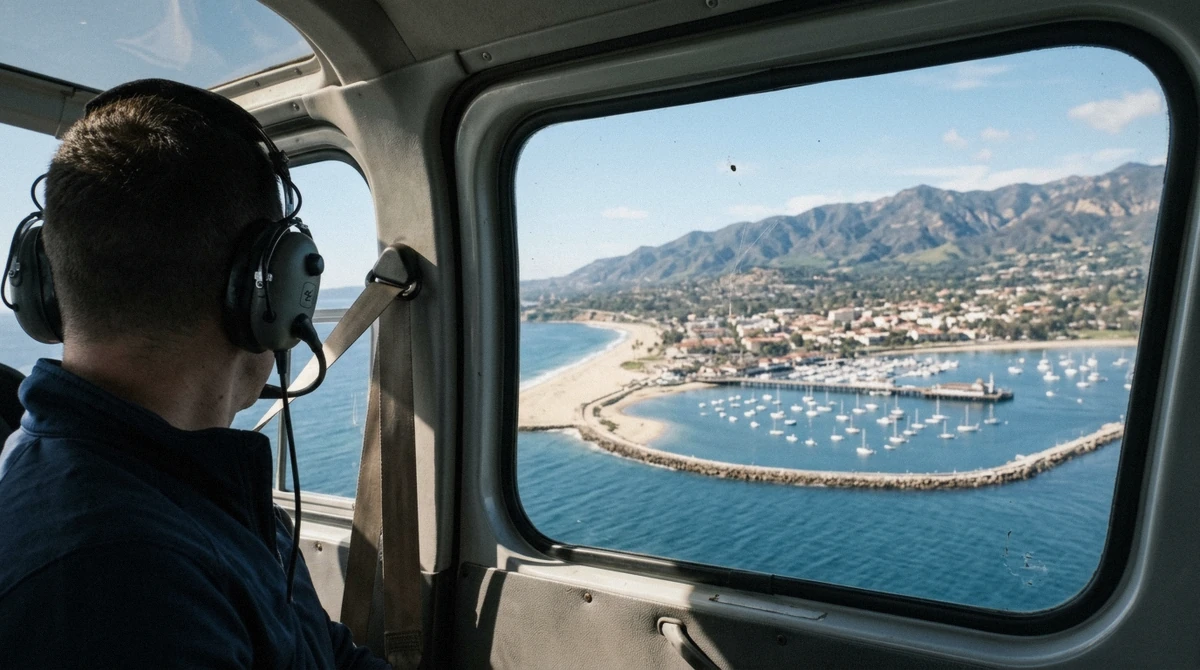
Quick answer
Arrive 15 to 30 minutes early, expect to be weighed at check-in, and expect your seat to be assigned rather than chosen. The whole process from arrival to landing runs under an hour even for the shorter flight, and the flight itself is over almost before the nerves have time to build.
Key takeaways
- You'll be weighed before boarding, because the aircraft is flown to a computed weight and balance, not out of curiosity
- Seats on the Santa Barbara Beach & Coastline Helicopter Tour and the Downtown Santa Barbara Helicopter Tour are assigned by that same weight math, so which window you get is a request, not a pick
- Plan on arriving 15 to 30 minutes before departure for the safety briefing
- The aircraft is a Robinson R44, seating up to three passengers alongside the pilot, so the cabin is snug but everyone gets a window
- There's no age limit, and children 23 months and under fly free as lap children
- Wear dark clothing. Light colors bounce off the windows in every photo you take, a detail the what you'll see guide assumes you already know
The Two Flights Covered Here
Everything below applies to both the coastline hop and the downtown loop; where the experience differs between them, it's called out directly.
 from $69
 Santa Barbara Beach & Coastline Helicopter Tour
A scenic 6-minute helicopter ride along the California coastline — fly over UCSB's campus and Campus Lagoon, Goleta Point, Goleta Beach, and soak in panoramic views of the…
- 6-minute coastal helicopter ride
- Fly over UCSB campus and Campus Lagoon
- Views of Goleta Beach and Goleta Point
- Santa Ynez Mountains and Channel Islands visible
 from $149
 Downtown Santa Barbara Helicopter Tour
A 12-minute private helicopter tour that extends the coastline flight into downtown Santa Barbara — sweeping views of the harbor, mountains, beaches, and the Channel Islands, with the…
- 12-minute private helicopter tour
- Downtown Santa Barbara from above
- Harbor, mountains, beaches and Channel Islands
- Wheelchair accessible
What Happens From Arrival to Take Off
The whole sequence, from pulling into the parking lot at Santa Barbara Airport to lifting off, follows the same order every time. Nothing here is a surprise once you've read it once.
-
15 to 30 minutes before departure
Arrive and check in
You'll check in at the operator's desk at Santa Barbara Airport. The exact meeting point comes with your booking confirmation, so you're not hunting for a gate on arrival.
-
Right after check-in
Weigh-in
Per FAA regulations, each passenger is weighed before the flight. This isn't singling anyone out. It's the same step for every passenger on every flight, and it's the reason your confirmation asks for an approximate weight when you book.
-
Before boarding
Safety briefing and headset fitting
A short briefing covers the aircraft, the doors, and how the headset works. The headset is how you'll hear the pilot and the pilot hears you for the rest of the flight, so it goes on before you climb in, not after.
-
At the aircraft
Boarding the R44
You step up into a Robinson R44, four seats total, one for the pilot and three for passengers. Boarding is quick. There's no long taxi or waiting on the tarmac once you're buckled in.
-
Wheels up
Take off
The R44 lifts almost straight up rather than rolling down a runway, which is usually the first thing that surprises first-time flyers. Within a minute or two the airport is behind you and the coastline opens up below.
Why They Weigh You and How Seats Are Assigned
A helicopter this size is flown to a computed weight and a computed center of gravity. That's the entire reason your weight gets collected at check-in and why nobody hands you a seat chart to pick from. The operator states it plainly: the maximum per-passenger seat rating is 300 pounds, and per FAA regulations, they weigh each passenger before the flight.
It isn't a judgment call at the desk. It's math that has to balance before the aircraft is safe to fly.
That same math decides who sits where. On the shared coastline flight you may be seated with passengers you didn't book with, since the operator fills every seat on that route to keep the fare affordable. The downtown tour is sold as a private group booking instead, so the cabin is yours and whoever you booked with, though seating within it is still set by the same weight and balance rule.
| Question | Answer |
|---|---|
| Why am I weighed? | The R44 is flown to a computed weight and center of gravity; passenger weights feed that calculation directly |
| What's the per-seat limit? | 300 pounds is the maximum per-passenger seat rating |
| Can I pick my own seat? | No. Seats are assigned by weight and balance, not by request, though you can ask for a side |
| How many passengers fly at once? | Up to three, alongside the pilot, in the Robinson R44 used for these tours |
| Do infants count toward a seat? | Children 23 months and under ride as lap children at no extra charge and no age limit applies |
Both flights we compare weigh passengers under the same 300 pound rule. Last verified: August 2026.
The Rules That Sit Behind the Flight
None of this is improvised. Commercial air tours in the United States operate under 14 CFR Part 136, the National Air Tour Safety Standards, which require a Letter of Authorization from the FAA, a mandatory passenger briefing, and a performance plan for the operator before a single paying passenger boards.
Part 91 or Part 135, and why it matters to you
There's a second layer worth knowing. An air tour that starts and ends at the same airport and stays within a 25 statute mile radius of it, which both flights here do, can be flown under Part 91 with that FAA Letter of Authorization rather than under the full Part 135 on-demand charter rules that govern longer, point-to-point trips.
For a passenger the practical difference is smaller than the regulation-speak suggests: either way the aircraft is flown by an FAA certificated commercial pilot, operating under a regime the FAA authorizes and actively inspects, and the operator is required to brief passengers before departure regardless of which rule applies.
| Rule | What it covers | Applies here? |
|---|---|---|
| 14 CFR Part 136 | National standards for commercial air tours: Letter of Authorization, briefings, performance plan | Yes, for every flight from Santa Barbara Airport |
| Part 91 with a Letter of Authorization | Air tours starting and ending at the same airport, within 25 statute miles of it | Yes, both flights we compare stay inside that radius |
| Part 135 on-demand charter | Longer or point-to-point commercial flights outside that 25 mile radius | Not applicable to the coastline or downtown routes |
None of this replaces the weight and balance conversation above. The two sit side by side: regulation sets the framework the operator flies under, and weight and balance is the specific engineering reason your weight is collected at the desk.
If You Are Nervous About Flying
Most of the nerves I hear about before a first flight aren't really about the helicopter. They're about the unknown: a cabin you've never sat in, a noise you've never heard, a door you're not sure how to open in an emergency. All of that gets addressed directly in the briefing before you ever climb in, and the headset means you can say something to the pilot the second anything feels off, mid-flight, not just before or after.
The R44 cabin itself is smaller than most people picture, closer to the front seat of a car than to a commercial jet cabin, and that closeness is usually what catches first-timers off guard more than the flying does. It settles fast once the aircraft is airborne and the ride evens out.
| Worry | The reality | What helps |
|---|---|---|
| The cabin feels too small once the doors close | Four seats total, snug but every seat has its own window and headset | Remember the briefing covers exactly what's within reach if you need it |
| What if I panic once we're airborne | You're on headset with the pilot the entire flight, not cut off | Say so. The pilot hears you the instant you speak |
| The takeoff will feel like losing control | The R44 lifts nearly straight up, a different sensation than a runway takeoff, not a rougher one | Expect the vertical lift ahead of time and it reads as smooth rather than sudden |
| I'll be the only nervous one in the group | Shared coastline flights carry a mix of first-timers and repeat flyers most days | Nobody on board can tell who's flown before and who hasn't |
If a specific fear is still sitting with you after the briefing, say something before the doors close, not once you're a few hundred feet up. The desk staff would rather hear it on the ground.
Motion Sickness and How to Head It Off
Both flights here run 6 to 12 minutes, short enough that most passengers never think about motion sickness at all. A handful of simple habits lower the odds further for anyone who knows they're prone to it on boats or in the back seat of a car.
- Get a full night's sleep before the flight rather than a rushed early morning after a late night
- Eat something light beforehand. An empty stomach and a heavy one are both worse than a small meal an hour or two out
- Watch the horizon and the landmarks outside rather than looking down at a phone screen while airborne
- Stay hydrated the morning of, but skip anything heavy in caffeine or alcohol right before boarding
- If you know ginger or an over-the-counter antihistamine-type remedy works for you on boats, take it with the same lead time you normally would, and ask a pharmacist about dosing rather than guessing
The short flight length genuinely works in your favor here. A 6 or 12-minute ride over a coastline gives motion sickness far less time to build than a longer charter would, which is one reason first-timers worried about it tend to report it was a non-issue once they were actually in the air.
What to Wear and What to Bring
Wear dark colored clothing. The operator is specific about this: light clothing reflects on the transparent windows, and that reflection shows up in every photo you take from inside the cabin, not just a few. Bring your camera or your phone, comfortable closed shoes, and not much else.
There's no dress code beyond that, and no gear to rent or fit beforehand.
- Dark colored top, to cut window reflections in photos
- Phone or camera, charged and with storage cleared
- Sunglasses, easy to remove for photos through the glass
- Closed, comfortable shoes rather than sandals
- Photo ID matching your booking name
- Confirmation email or booking reference, printed or on your phone
- A light layer if you're on an early or late flight, since the cabin isn't heavily insulated
- Nothing loose or bulky in your pockets that could shift once you're seated
There's no age limit on either flight, and children 23 months and under ride as lap children at no extra charge, so a family bringing a toddler doesn't need to plan around a minimum age the way some tours require.
Getting a Photograph Worth Keeping
The single biggest photo mistake first-timers make is pressing the lens straight against the glass and shooting through their own reflection. Hold the camera or phone a few inches off the window instead, angled slightly, and the reflection mostly disappears, especially once you're already in dark clothing rather than a white or light-colored shirt.
A phone camera is genuinely enough for this flight. There's no need to bring a separate camera body just for a 6 or 12-minute ride, though anyone who already shoots with one won't be short on light at almost any hour the tour runs. Skip the flash entirely.
It does nothing useful through glass at altitude and mostly just lights up the window itself.
Which Seat Situation Fits Your First Flight
If you'd rather not share the cabin with strangers
book the Downtown Santa Barbara Helicopter Tour, sold as a private group booking rather than shared seats
If you're flying solo or as a pair and want the shortest possible first flight
the Santa Barbara Beach & Coastline Helicopter Tour runs 6 minutes and shared seats keep the price down
If you're bringing a toddler
confirm the lap-child policy at booking; children 23 months and under fly free with no minimum age on either flight
If you're nervous about the price as much as the flight
read the full price breakdown before you book so nothing at checkout surprises you
Frequently Asked Questions
What happens before a helicopter tour takes off?
Check in 15 to 30 minutes early at Santa Barbara Airport, get weighed, sit through a short safety briefing and headset fitting, then board the Robinson R44. The whole sequence from arrival to wheels-up is covered step by step above.
Why do helicopter tours weigh passengers?
Because the aircraft is flown to a computed weight and center of gravity. Per FAA regulations, each passenger is weighed before the flight, and the maximum per-passenger seat rating is 300 pounds.
Can I choose my seat on a helicopter tour?
No. Seats are assigned based on the same weight and balance calculation that governs the weigh-in, not by passenger preference. You can ask for a particular side, covered in what you'll actually see from each one, but it's a request, not a guarantee.
Will I get motion sick on a helicopter ride?
Most passengers don't, especially given how short both flights are, 6 and 12 minutes. Sleeping well beforehand, eating something light, and watching the horizon rather than a phone screen lower the odds further for anyone prone to it.
What should I wear on a helicopter tour?
Dark colored clothing, since light clothing reflects on the windows in photos, plus comfortable closed shoes. There's no formal dress code beyond that.
Is there a minimum age for a first helicopter ride in Santa Barbara?
No age limit applies on either flight, and children 23 months and under ride as lap children at no extra charge.
Is the flight regulated the same way as a commercial airline?
It's regulated under a different but specific framework: 14 CFR Part 136 governs commercial air tours, and flights that start and end at the same airport within 25 statute miles, which both of ours do, operate under Part 91 with an FAA Letter of Authorization rather than full charter rules.
None of this is complicated once you've been through it once. Arrive with time to spare, expect the weigh-in as routine rather than personal, let the briefing do its job, and hold the camera a few inches off the glass instead of pressed against it. The rest is mostly just watching the coastline go by faster than you expected and being surprised at how quickly the nerves you drove there with are gone.