Best Time for a Santa Barbara Helicopter Tour: Month-by-Month Guide

The best time for a santa barbara helicopter tour is September and October, when the coastal marine layer that grips this coast in late spring pulls back and mornings tend to open clear. May and June carry the greyest starts of the year, locally called May Gray and June Gloom, while November through March is the rainy season and the one stretch most likely to ground a flight outright. Tours run 9am to sunset, seven days a week, and the window for that last flight shifts by more than three hours across the year. Below is the month-by-month picture, the best time of day, and what actually happens if the marine layer cancels your slot, for anyone weighing scenic helicopter rides in Santa Barbara.
Quick answer
September and October are the best time for a Santa Barbara helicopter tour, once the coastal marine layer that dominates May and June has thinned and mornings run clearer more often. Tours operate 9am to sunset, seven days a week, and the marine layer, not rain, is the real reason flights get delayed or grounded here. Both fares we compare carry free cancellation for exactly that reason.
Key takeaways
- Best window: September and October, when mornings are clearest most often
- Toughest window: May and June, known locally as May Gray and June Gloom
- Avoid stacking your only free morning in the rainy season, roughly November through March
- Sunset swings from about 4:49pm in early December to about 8:16pm in late June, moving the last flight of the day with it: the 12-minute downtown flight is the one worth saving for that light
- Late morning through afternoon is the safer bet once the marine layer has had time to burn off
- Both fares we compare carry free cancellation if the morning doesn't clear, including the 6-minute coastline flight, and what the season puts in the view changes month to month
The Flights Timing Applies To
 from $69
 Santa Barbara Beach & Coastline Helicopter Tour
A scenic 6-minute helicopter ride along the California coastline — fly over UCSB's campus and Campus Lagoon, Goleta Point, Goleta Beach, and soak in panoramic views of the…
- 6-minute coastal helicopter ride
- Fly over UCSB campus and Campus Lagoon
- Views of Goleta Beach and Goleta Point
- Santa Ynez Mountains and Channel Islands visible
 from $149
 Downtown Santa Barbara Helicopter Tour
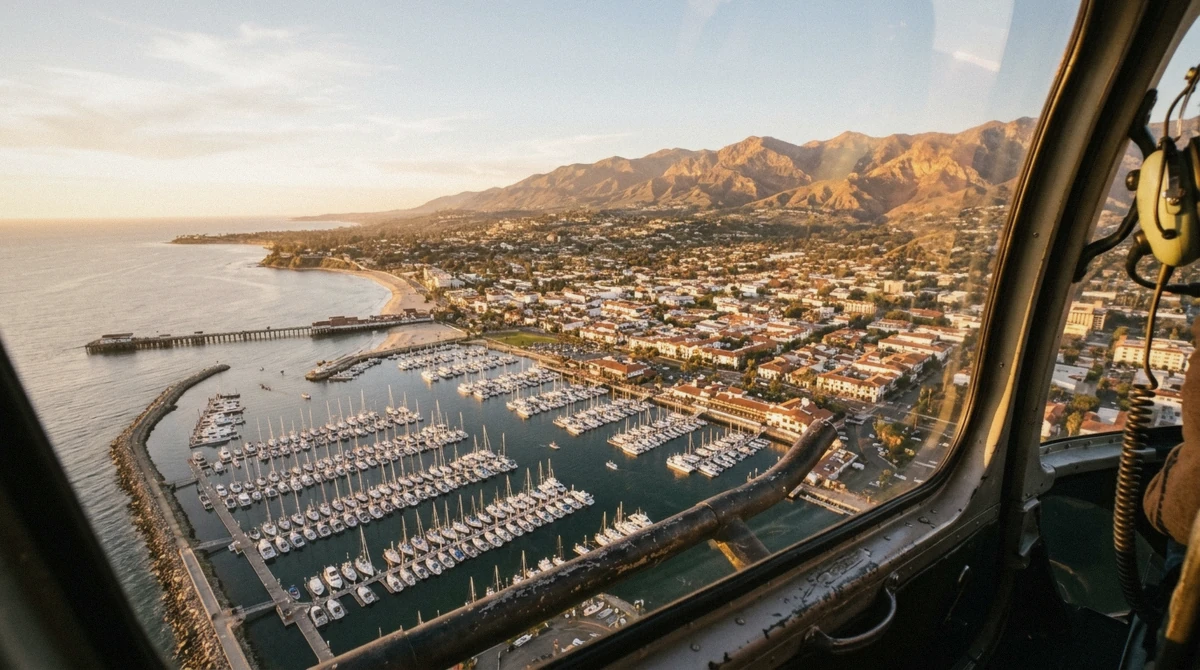
A 12-minute private helicopter tour that extends the coastline flight into downtown Santa Barbara — sweeping views of the harbor, mountains, beaches, and the Channel Islands, with the…
- 12-minute private helicopter tour
- Downtown Santa Barbara from above
- Harbor, mountains, beaches and Channel Islands
- Wheelchair accessible
The Short Answer on Timing
September and October are the clearest, most reliable stretch of the year to fly over Santa Barbara, once the offshore sundowner winds that arrive in early fall have pushed the marine layer away from the coast. Late spring and early summer, May and June specifically, run the greyest mornings of the year even when it feels sunny a few miles inland. The window to plan around outright is the rainy season, roughly November through March, when the few genuine storm cancellations of the year happen.
None of this means the other months don't fly; most days across the calendar do. It means September and October ask the least patience from your schedule, while May, June and the winter rains ask the most. For what those minutes in the air actually buy and whether they're worth it on any given trip, see our worth-it breakdown.
The Marine Layer Is the Thing That Grounds Flights
Rain is not the main reason a sightseeing flight gets delayed on this coast. The coastal marine layer is: a shallow deck of low stratus cloud that forms over the cool Pacific and pushes inland overnight, then burns off as the land warms through the day. Locally, the two roughest stretches of it have names.
May Gray covers the grey mornings of May, and June Gloom covers June, the two months when this cloud deck sits thickest and lingers latest into the day, even while inland valleys a short drive away sit under clear sky.
The daily rhythm in marine-layer season is fairly consistent: cloud at first light, burn-off through the late morning, clear afternoons, and the cloud reforming again after sunset. What isn't consistent is exactly when the burn-off happens on a given day; it cannot be predicted a week out, which is why a September morning can still occasionally run grey and a June afternoon can still turn out clear.

Month by Month Over Santa Barbara
Read the Verdict column as a general lean, not a promise about any specific day; burn-off timing and storm timing both shift year to year.
| Month | Typical Conditions | Notes | Verdict |
|---|---|---|---|
| January | Rainy season, storm risk highest | Gray whale migration underway | Weather-dependent |
| February | Rainy season continues | Gray whales still passing through | Weather-dependent |
| March | Tail end of the rainy season | Gray whale season winding down | Improving |
| April | Marine layer starting to build | Last of the gray whales, humpbacks arriving | Good, transitional |
| May | May Gray, grey mornings common | Humpback season underway | Toughest for morning clarity |
| June | June Gloom, the greyest month | Humpbacks present | Toughest for morning clarity |
| July | Marine layer easing | Humpback season continues | Improving |
| August | Generally clearer, some morning cloud | Humpbacks present | Good |
| September | Offshore winds start pushing the layer back | Humpback season continues | Best overall |
| October | Usually the clearest, warmest stretch | Humpbacks tapering off | Best overall |
| November | Rainy season begins | Gray whale migration starting | Weather-dependent |
| December | Rainy season, shortest days | Gray whale season underway, Night Flight after dark | Weather-dependent |
The pattern across the year is really two seasons layered on top of each other: a marine-layer season that peaks in May and June, and a rain season that runs November through March. September and October sit outside both, which is the whole reason they're the pick.
Best Season by Traveler Type
If You're a photographer chasing clear light
Aim for September or October, when the marine layer has pulled back and mornings run clear more often
If You're traveling with family and want the calmest odds of the flight simply going ahead as booked
September and October again; the rainy season and the May Gray or June Gloom window both carry more delay risk
If You're a first-timer nervous about a cancellation
Avoid the November through March rainy season if your schedule can flex; it's the stretch most likely to ground a flight outright
If You want to spot whales from the air
December through April for gray whales, or May through November for humpbacks; a helicopter flight is not a dedicated whale-watching trip either way
If Your travel dates are already fixed in May or June
Book the latest morning slot you can and lean on free cancellation if the marine layer hasn't cleared
Best Time of Day for Light and for Air
Later morning through early afternoon is the more reliable window most of the year, simply because that's when the marine layer has had the most time to burn off. Booking the first flight of the day during May Gray or June Gloom season raises your odds of flying into lingering cloud; booking a slot after the marine layer typically clears improves them.
Santa Barbara's coast faces south, which is unusual for California. Practically, that means the sun tracks across the water through the day rather than dropping behind it, morning light tends to hit the Santa Ynez Mountains first, and afternoon light shifts toward the beaches and the harbor. Neither the coastline flight nor the downtown flight locks you to a single fixed departure time, so picking a later morning slot over a first-light one is a genuine, actionable choice rather than a guess.
Sunset, the Last Flight of the Day and Flying After Dark
Tour hours run Monday to Sunday, 9am to sunset, and sunset itself moves a long way across the calendar here. The earliest sunset of the year is about 4:49pm in early December; the latest is about 8:16pm in late June. That's a swing of well over three hours, which means the last bookable flight of the day in December closes out mid-afternoon, while in June it's still available into the evening.
Neither of the two fares we compare is an after-dark flight. The operator's own Night Flight, 18 minutes from $179, is the dedicated after-dark option on their list, covering downtown and the coastline lit up after the sun goes down. If you specifically want to fly after sunset, that's the tier to look at rather than the coastline or downtown flights we compare here.
What the Season Puts in the View
Whales pass through the Santa Barbara Channel on a seasonal rhythm worth knowing before you book, even though neither flight here is built as a dedicated whale-watching trip. Gray whales migrate through roughly December through April, and humpback whales are present roughly May through November, meaning some whale activity in the channel is possible across most of the calendar.
Treat any sighting as a seasonal possibility, not a promise; six or twelve minutes over the coastline is a short window for spotting anything specific. What the season more reliably changes is the color and clarity of the water and the amount of haze on the horizon, both tied to how thick the marine layer has been that week. The islands themselves stay a shape on the horizon on both flights, not a stop on the route, whatever the season.
The same seasonal shift also changes what the mountains and the coastline look like from above, independent of any wildlife. Through the rainy months, the Santa Ynez Mountains behind the city often carry a sharper green than later in the year, since the hills green up after rain the way most of coastal California does. By late summer and into September and October, that green fades toward gold and brown, and the air tends to run clearer at the same time, so the mountain wall reads more sharply defined against the sky even as its color shifts.
Neither look is better than the other, but they are genuinely different, and which one you get depends entirely on when you book.
If Your Flight Is Cancelled
Both fares we compare carry free cancellation, which is the practical answer to the anxious version of this question: a marine-layer or storm cancellation does not mean losing your money. The operator makes the call based on conditions that morning, since the marine layer's burn-off timing genuinely cannot be forecast a week out, and light rain often does not stop a flight the way a full storm system does.
A short scenario table covers most of what actually happens.
| Scenario | What Happens | Your Move |
|---|---|---|
| Morning marine layer hasn't cleared | Flight may be delayed to a later slot the same day | Ask about a later same-day time rather than assuming it's off entirely |
| Flight is cancelled outright for weather | Free cancellation applies on both fares we compare | Rebook for a different day, ideally not the last day of your trip |
| Light rain, no storm system | Flights often still operate as scheduled | Don't assume rain alone means cancellation; check your booking status directly |
| You're unsure the morning of your flight | Conditions can still change in either direction | Confirm with the operator before heading to the airport rather than guessing |
The biggest practical safeguard is scheduling: book your flight earlier in your trip rather than on your last available day, so a weather delay still leaves room to rebook before you leave. Last verified: August 2026.
Frequently Asked Questions
What is the best month for a helicopter tour in Santa Barbara?
September or October, once the offshore sundowner winds of early fall have pushed the marine layer back from the coast and mornings run clear more often than in late spring.
What is May Gray and June Gloom?
The local names for the coastal marine layer at its thickest, a shallow deck of low cloud that forms over the cool ocean and covers May and June mornings more than any other stretch of the year, even when inland areas sit under sun.
What time of day is best for a Santa Barbara helicopter flight?
Later morning through early afternoon, once the marine layer has typically had time to burn off. A first-light slot during May Gray or June Gloom season carries the highest odds of flying into lingering cloud.
What happens if fog or the marine layer cancels my helicopter tour?
Both fares we compare carry free cancellation. The operator decides based on conditions that morning, since burn-off timing can't be predicted a week ahead, and you're not left simply losing your money.
Can you fly over Santa Barbara at night?
Not on the two fares we compare, which operate within the 9am to sunset window. The operator's separate Night Flight, 18 minutes from $179, is the dedicated after-dark option on their list.
When can you see whales from a Santa Barbara helicopter tour?
Gray whales migrate through roughly December to April, and humpback whales are present roughly May to November. Neither flight is built as a whale-watching trip, so treat any sighting as a seasonal possibility rather than a guarantee.
Is the rainy season a bad time to book?
Roughly November through March is when the few genuine storm cancellations of the year happen. Flights still run on most days in that window, but it carries more weather risk than September or October, and free cancellation is the safeguard if a storm does roll through.
There's no month on this coast where a flight is guaranteed to go exactly as planned, and September or October only shortens the odds, it doesn't erase them. If your dates are already fixed for May, June or the winter rains, book the latest reasonable slot in your trip rather than the first day you land, and let free cancellation do its job if the marine layer doesn't cooperate. The view is worth the flexibility either way.